From Kilimanjaro to the Table Mountain.By Warren Bright


 Cape Peninsula University of Technology Cape Town Campus
Its a great pleasure to make the history at Cape Peninsula University of Technology,Cape Town Campus. The road to success is not straight. There is a curve called Failure, a loop called Confusion, speed bumps called Friends, red lights called Enemies, caution lights called Family.
Warren Bright pose on modelling photoshot
You will have flats called Jobs. But, if you have a spare called Determination, an engine called Perseverance, insurance called Faith, a driver called Jesus, you will make it to a place called Success.
 Warren Bright CPUT PR Graduates Student 2004-2007
What can I say? On graduation day I also want to congratulate the Ladies and Gentlemen who devote their professional lives to making the Cape Peninsula University of Technology (CPUT),Cape Town Campus a place of excellence and achievement the outstanding Public Relations Management department of business faculty.
 Timothy Lamberetchts CPUT PR Graduates Student 2004-2006
I want to join hands with the graduates in saying thanks to the people who did so much to make this day (16 April 2008) possible the ones who rooted for us, believed in us, prayed for us, and paid for us, the parents of the PR class of 2004-2007.
It's been a long and memorable journey, one that has consumed 3 years of our lives,,,,,actually 4 or 5 for some of us,,,,,but whose really counting--,right moms and dads? But the fact is, we all made it here together and are soon to be graduates of the CPUT,Cape Town South Africa.
But as we head off into this place some call the "Real World" let us never forget where we all came from,,Our parents and siblings gathered around to give us words of encouragement,,,[Don't drink too much].
As we told our parents goodbye, many of us cry,and saw our mothers,,,,,and sometimes our fathers cry for the very first time in our lives,because they wish us for the best. We tried to hold back the tears but the emotions got the best of us as well. As we watched our family drive away, we knew we wanted to be with them but we also knew it was time to move on. I always cry when I separate with my Mum and the people I love the most, I real hate saying "goodbye" but life goes on. As we entered Cape Technikon eventually Cape Peninsula University of Technology CPUT, some of us lived in the residence our Freshman year.

This was the only time in our lives where you will have a TV, Toilet, Bed, and Fridge all within 5 feet of you,,,,,or at least that's what I thought until I saw some apartments a few years later,, but regardless,,,,Freshman year does bring back some good memories Sophomore year we got a little bit older and a little bit wiser,,,,,[Freshmen Girls], we found out about "The Key" and realized that 8:00 classes were no longer a reality.
When we were first years, we started to schedule our classes around our sleep patterns and worried about that big internship before Senior year,,,,,[Working for our parents]. That was also the year most of us turned 21 and above,,,,,
Then we become seniors and knew we had to compile everything the CPUT had given us and sell ourselves on a single sheet of paper to get that great job,,,,,"I as number one brand" thank you Marian Pike our Media studies Lecture for such wonderul and powerful topic… Regardless, there is one thing that connects us all. Within each and every one of us is a Voice. I am not sure where it comes from. Maybe it's the natural or the supernatural, maybe its from within or a land far away I don't know.
This voice speaks to us when we are younger and we think we can conquer the world. As we get older, however, other people tell us everything we are un-able to do in life and sooner or later most people start believing this until one day that voice is gone and never comes back again. Thank you Elza Myburgh the best lecture of Communications Science and English for Public Relations for creating the bright future for us.
CPUT has helped us Find, Listen, and Follow that inner voice, that Dream,,,,,that Desire to DARE to be the person we were meant to be. CPUT is tough and certainly has its ups and down but it has taught us many lessons along the way. When we came to Cape Tech/CPUT that first time at Freshman Orientation we all fell in love,,,,,some of you with your Freshman Orientation leaders,,,,, and others with the fact that you were a new CPUT Bulldawg.
Regardless love in some form or another had its fare share with all of our hearts. Maybe you moved on quickly or maybe it takes half a decade just to get over that one person but the fact is there are those people out there who make an impression in your life and on your heart that you,,,,,will never forget.
Thanks to my classmates 2004/2005 Tim, Sofie, Tanya, Lamees,Olivia, Mitchel ,Catlin and Jaco you guys helped me a lot,Just keep in mind that I real appreciate.To Stacey Carney,we will always Miss you,we love you,REST IN PEACE.You passed away in a tragic car accident on Saturday morning,few days to start your final exams,I know your in the better place and smile down on us says every thing is ok,we dedicate this graduation to you,because we love you.
Some people get married, some people move on and others of us stay single knowing that one day our time will come,,,,,[well at least that's what I keep telling myself]. So if you could endulge with me for just one second,,,,,look to your left,,,,now look to your right,,,,Now grab the hands of those beside you,,,,,oh I'm serious here people,,,,come on grab those hands.
My point,,,,they say that your chances are greatest for finding love in life during your time in university. The way I see it (look at watch),,,,There is about 30 minutes left before graduation is finished and university is over.Some of us will continue studying,some of us due to some circumstances the journey will end here and open the new chapter. There's still time people -- We must Act FAST!
All I can say is that love is a work in progress. Never let yourself get so angry that you stop loving because one day you will wake up from that anger and the person you love will be gone. Remember that marriage is indeed a commitment, the wedding ring is a circle of trust and the time you spend with your significant other and those treasured moments you spend with the children you bring into the world are more important that any job you will ever get or money you may make. We are the luckiest graduating class in the continent ever.
This University has allowed each and every one of us the ability to believe in ourselves and has instilled in us the value of giving a little bit more of ourselves than people may ever expect. As we go out and descend upon the world,,,,,Always leave more than anyone expects. Our lives are not all the same, but the voice inside of us is. Where it leads you-may all of you follow it.
Sometimes we go back, sometimes our life changes, the race is long but in the end, it's only with ourselves. Challenge the Process, Disregard the Status Quo, sometimes you'll be ahead, sometimes you'll fall behind, but always trust in Yourself. For as a great writer once wrote, "never tell a young person that anything cannot be done. God may have been waiting centuries for someone ignorant enough of the impossible to do that very thing."
One little boy on a continent far away in the village asked me to make a promise: a simple request to always remember him. My time in South Africa helped me truly rediscover the inner voice within me, for the past year I have followed this inner voice-and my heart-to try and help abandoned children with AIDS and traumatised have a series of unforgettable experiences-before the inevitable.

So with the encouragement and assistance from several other individuals, I begin to work with International NGo, Save the Children UK-Tanzania Programme in Zanzibar, as a Corporate Communications Coordinator a non-profit organization . Although I am only one person trying to make a difference, I know that I am also keeping a promise to one little boy "Justine" who called me his best friend. "I as Number one Brand" Currently am working with Tanzania Electric Supply Company Limited (TANESCO) as the Corporate Communications Officer External Affairs.
When working with Redcross Childrens Hospital Trust in Cape Town,the path is not easy and often times I struggle trying to figure out fundraising, where to get the money to even get this off the ground, or where to turn for help. Sometimes I wonder what I am even doing pushing everything I have worked so hard for to the side in order to take a risk that no one understands and go out on a limb so far that the chances are it might break before I even reach it.
 Warren Bright,CPUT Graduate PR Student 2007
But it's in those moments that I remember back to the final time that I walked away that summer. Some friends were a little too tired to say goodbye, others were a little too sick, and one friend was still at the big grey stone at the back sleeping. It was as if they felt a pain I didn't understand. And I realized just how fortunate I was because, as I stand here today, somewhere out there, somewhere in a land far away, there is a little boy who never had this same opportunity.
To the Graduating Class of 2005/2007, let us be a HERO for someone or something in life. Just like you, I am searching for answers,,,I want to be someone's HERO,,,and maybe one day that person will be a HERO for someone else who knows? But follow that inner voice regardless of how long it might take or how difficult it may be, because in the end, there is probably some little boy or girl, some cause, or something out there that is speaking to you.
Maybe even at this very moment, that is just waiting for you to listen. We may not understand the world around us, we may not always make the right decisions, and we may not always succeed in this game we call life. But on this day as we step through the Arch our life will take on a new meaning but our times here in university will last forever.There were friendships built and relationships lost, there were laughs that have brought us together and tears that have driven us apart, but it is all of this that has made college worthwhile.
One of the things I love most about our continent and our profession "Public Relations Management" is that we have such great opportunities. Africa there is still changes the future is bright for the second chance guys let join hands together to make changes from Cape Town to Cairo. Most of us end up needing one. And when we've gone on to accomplish something, we can be that much more grateful. Gratitude, in general, is a good habit to get into.

It is usually a correct appraisal of our situation. Most of us are able to succeed and rise in the world because someone helped out along the way whether it was a memorable teacher, or a boss who handed us a great opportunity, or the person who took a chance and gave us the first big break in our career.
A grateful heart is an honest understanding of all that we have been given, and all that is expected in return. There is always the temptation to forget this to carry ourselves with an air of entitlement, as if good things come to us by right. They rarely do. And life has a way of working out better when we don't take things for granted, when we have a long memory for what others have given us, when we look for the blessings, great and small, that come with every day we're alive on this Earth. For all of us, this day of ceremony in the Mult-Purpose Hall CPUT Cape Town Campus,will stand out forever as a marker of gifts well used, aspirations fulfilled, hard work rewarded. Its my wish and It's been my privilege to share it with you and your families. Sure, I generalize. There is a certain thrill in figuring out a particularly nitty contract provision; there is a certain excitement in producing a well-written brief. But it's a different sort of stimulation--related more to problem-solving than to notions of achieving justice (which, I'll bet, at least sixty percent of us made reference to in our application essays.) This is not unique to law.
Patients can become tests and intellectual puzzles to the fourth year medical student. Movies can become technical conundra to the second year film student. This phenomenon is, perhaps, part of higher education itself. But now here we are. Graduating. While our educational process is by no means over, opinions, briefs and oral arguments can again be inspirational, rather than only instructional. Parties can become human, rather than names on a page. And our daily work can and will affect others' lives, rather than just our grades. We now have the opportunity to reassemble everything with the tools we've gained. We just have to remember that we can. Thank you DR Van Der Merwe,Prof Slabbert,MR Pierre Le Roux,Deidre Porthen,DR Nirvana Bechan,Daniela Charles,Alen Young,Mpho Chaka,and Prof Braam Rust.You made us proud for ourselves,became professional public relations practitioners, and for this reason,CPUT the Department of Public Relations Will always have a special place in our hearts. Again thank you very much. I want to say thank you to everyone, thank you to my family,thank you Mama,I love you so much and thanks to each and every member of the Graduating Class of 2006/2007. Remember,the journey beggined 2004,some of us end 2006 and eventually we end 2007.


Cant forget nice time we shared together at PIAZA the most beautful place in the campus ever, all fun presentation we did together, fundraising events,without forgeting our open day the best events ever in the campus 2004/2005.
May you find happiness in all you set out to achieve,good lucky for the jobs and go on to become the best mothers and fathers of the children you may one day bring into this world. "I've been waiting for this day for so long.And this year I have the honor to graduate alongside so many of my peers in what I feel to be one of the most esteemed and worthy graduating classes that has had the privilege to pass through CPUT. Remember,time is not time if its not the God's time,I always said to myself,I shall wait for the God's time,because I know the God's time is the best,I have come this far by faith".Today some one proud for me,yap my Mum, of course am proud for myself and am proud for CPUT for creating a bright future for me. Graduation: The End of a Journey, the Start of the New Beginning. I love you all and I will always miss you so much.
Now let's have fun.  Warren Bright the super model on Catwalk
 Tim,this dude is always fun and charming
 Warren Bright CPUT Graduate PR Student 2007 Super Model for sure!
Congratulations and Best of luck!  Cape of Good Hope! Cape Town, a.k.a Mother City ,this is where hope begins.
Much Love,
Warren Bright,
Cape Peninsula University of Technology.
Public Relations Management Graduates Student 2007
***********************************END************************************

 ‘’ Mind is like a Parachute, function when it open.’’
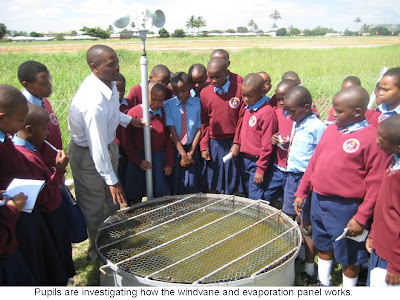 Always hope for the best, even if tears will get you sympathy, sweet will get you progress. The sky is no limit.Currently, Tanzania is struggling to make gradual change to its education system from lower level ( Primary Education ) to high level ( University ). In educating teachers and curricular improvement.Some of the programmes are sounding good.
 As educationist, I am a stake holder of those challengies on improving education system in the country; cos I know ‘ Don't destroy if you can't create.’ Am teaching science lesson from grade one to grade seven. What I did, is I learning by doing. Learning by doing – through experiments, observation, study tours, projects and discussion.Live and learn. My friend LIFE is what you make it. Smile .It cost nothing but creates much.
 As we agree in mind, What the eyes do not see, the heart does not weep for. What does not kill you strengherns you!By that way we are focusing straight towards any challenge which will come across us.The best way to escape from your problem is to solve it. It is not possible to turn back the clock but you can wind it up again.


 The country's three decades of civil war ended two years ago.


 Why are they poor?


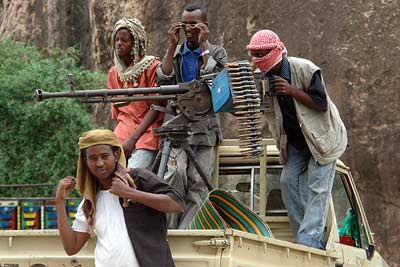 Somalis warn the UIC not to throw us in yet another war with the TFG or get absorbed in this expensive war on terror raging on between Bush and Bin Laden. They should know that while away in the war there are international mafia who suck all our natural heritage and resources while letting our people die from lack of food and medical attention. So in that case they should not go to war.